AI · Strategy
What the Internet May Be Telling Us About Where AI Is Going
Sashi Chimala · May 2026 · 8 min read
The internet’s first lessons
Every major technology wave begins with excitement, skepticism, failures, and eventually a few breakthroughs that reshape behavior.
The internet was no different. Some ideas arrived too early.
Webvan is a classic example. It tried to make grocery delivery work before logistics, economics, and consumer habits were ready.
The idea was not wrong. It was simply early. That same period also produced unexpected winners.
The App Store did not invent mobile computing. It changed behavior. It turned phones into platforms and enabled entirely new categories of software and habits.
That pattern matters.
The first version of a technology is rarely its final form. The real transformation usually comes when the technology becomes natural.
Thinking in phases
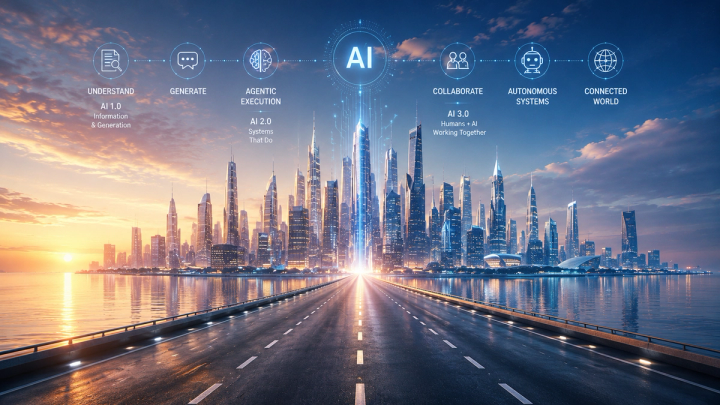
This is why it helps to think about both the internet and AI in phases. The internet did not arrive fully formed. It evolved. One way to look at that journey is through three broad phases:
Web 1.0 — Information
The web made information accessible. People could browse, search, read, and retrieve knowledge. Information moved online.
Web 2.0 — Participation and transactions
The web became interactive. People created, shared, collaborated, and transacted. Users became participants.
Web 3.0 — Human + device participation
The web expanded beyond users. Devices, sensors, systems, machines, and connected infrastructure became participants. Homes became connected. Wearables became connected. Machines began continuously feeding and consuming data.
If that lens is useful for understanding the internet, it may also help explain AI.
AI 1.0 — Intelligence
AI understands, summarizes, recommends, predicts, and generates. It is useful, but largely reactive. A person asks. The system responds.
AI 2.0 — Agentic execution
AI becomes agentic. It can take goals, break them into steps, use tools, execute workflows, and complete tasks. It starts doing work instead of merely describing it. Between execution and broader participation may come an intermediate layer: trust.
AI that can act requires permissions, supervision, memory boundaries, auditability, escalation paths, and revocation.
The next wave may not just be better agents. It may be better systems for governing them.
AI 3.0 — Human + machine collaboration
AI expands beyond software. Agents, robots, machines, vehicles, and connected systems become participants. AI moves from isolated assistance toward coordination across people, software, machines, and the physical world.
That is a much bigger shift than many people realize. Once technology begins coordinating action instead of merely displaying information, the shape of computing changes.
The internet may already have shown us the pattern. The question is whether AI follows it.
Phase 1: Information
The internet’s first phase was about information becoming accessible.
AI’s first phase may have been about intelligence becoming accessible.
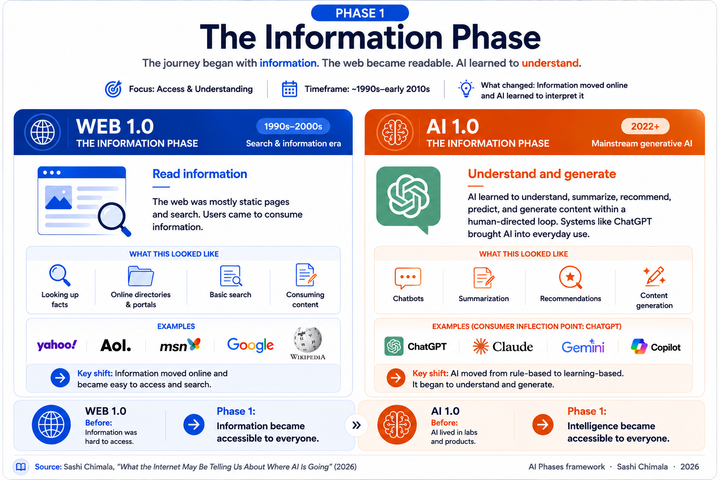
Web 1.0 brought static pages, search, and information retrieval to ordinary people. AI 1.0 brought understanding, summarization, recommendations, and generation.
For decades AI largely lived inside labs, products, and research organizations. ChatGPT changed that. It became the consumer inflection point that introduced AI to ordinary people and made intelligence feel accessible.
Before: Information was hard to access. AI lived in labs and products.
After: Information became accessible to everyone. Intelligence became accessible to everyone.
Phase 2: Agentic Execution
The internet’s second phase moved from reading to participation. People began creating, sharing, transacting, collaborating, and building.
AI appears to be entering a similar transition.
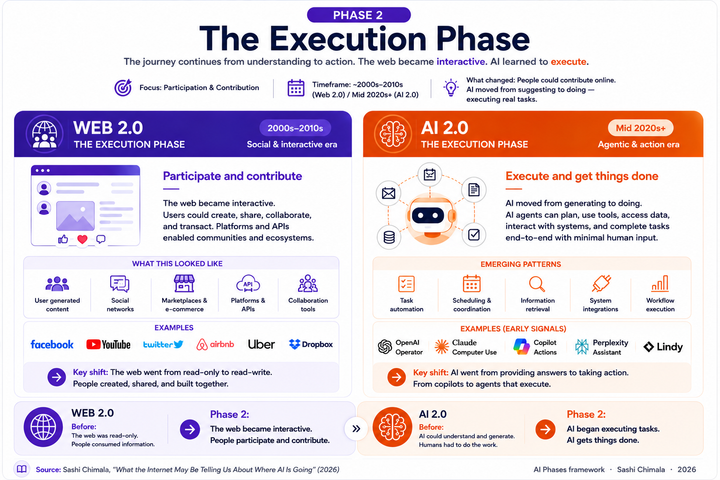
AI is moving from understanding to execution. This is the rise of agentic systems. AI can now plan, use tools, retrieve information, interact with software, and execute tasks. It moves from answering questions to doing work.
This shift changes what software means. Instead of software waiting for humans to click buttons, humans increasingly delegate outcomes.
Book this. Draft that. Schedule this. Complete the workflow.
That is a much bigger transition than better chat. It is the movement from intelligence to execution.
What will rhyme
A lot of the internet era will rhyme with AI.
First comes fear. People worry about trust, privacy, misuse, and control. Then come standards. Then better interfaces. Then habits.
Eventually the technology becomes so embedded in daily life that it feels obvious in hindsight.
The internet needed payments, identity, security, and distribution before commerce felt safe.
AI will likely need similar layers:
• Permissions
• Audit trails
• Memory
• Revocation
• Accountability
The finance industry learned early that adoption scales only when people feel protected.
AI may need its own version of that lesson. We should also expect the same cycle of hype and disappointment. Some AI products may be Webvan-like: ambitious, expensive, and too early.
Others may become App Store moments: quiet at first, but enabling entirely new categories of behavior.
Organizational memory
One under-discussed consequence of this shift may be organizational memory. For decades, companies have repeatedly lost knowledge when employees leave. Processes disappear. Context disappears. Relationships disappear. Experience walks out the door.
AI changes that possibility. Persistent AI workers may retain preferences, workflows, formats, historical decisions, institutional knowledge, and execution history over time.
Organizational memory may stop living only inside people. It may increasingly live alongside them. This could become one of the largest competitive advantages of AI adoption. Not just automation. Retention of institutional intelligence.
What will not rhyme
At the same time, AI is not simply the internet replayed.
The internet mostly helped us find and exchange information. AI can do that. But AI can also act. That changes the stakes.
A bad search result is annoying. A bad agentic action may cost time, money, or trust.
AI also introduces memory and continuity. The best systems may not feel like tools we occasionally visit. They may feel more like persistent partners that know preferences, context, goals, and history.
That creates a different relationship. And a different dependency.
Human organizations created managers because work required coordination, supervision, escalation, and accountability. AI workers may require similar structures. Goals. Guardrails. Supervisors. Performance measurement. Escalation models.
The future may not just be agent creation. It may be agent management.
Then there is the physical world. Robotics may become the next extension of this trend as AI moves from digital work into physical execution. Warehouses. Homes. Factories. Mobility. Machines working alongside people.
What comes after execution?
The internet eventually expanded beyond users.
Phones became participants. Watches became participants. Homes became participants. Cars became participants. Machines became participants. The web expanded beyond its original participants.
AI may do the same.
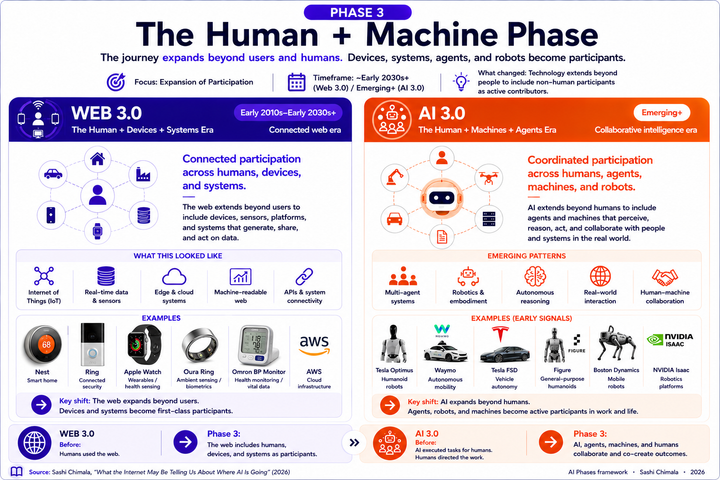
The journey expands beyond users and humans. Devices, systems, agents, and robots become participants.
This is where AI stops feeling like software and begins feeling like infrastructure.
Humans may increasingly work alongside:
• AI agents
• Robots
• Autonomous vehicles
• Connected machines
• Persistent digital workers
This is also where robotics enters the story.
Warehouse systems. Factories. Homes. Mobility. Healthcare. Embodied execution.
AI moves beyond screens.
The new surprises
The internet gave us surprises nobody fully predicted: Social media. Streaming. Ride-sharing. Creator economies. App ecosystems.
AI will likely create its own surprises.
Some possibilities include:
- Delegated commerce, where agents transact on our behalf.
- Machine customers, where software becomes the buyer.
- Persistent assistants with memory.
- AI workforces, where multiple agents operate as persistent teammates with roles, responsibilities, and supervision.
- Physical-world participation through robots and machines.
These are not merely better versions of old software. They are new behaviors.
The iPhone moment for AI
The iPhone did not invent the internet. It made it habitual. It moved computing into daily life.
AI may need a similar inflection point.
Products such as OpenClaw may become important if they make agents feel persistent, personal, and close enough to everyday life that people stop seeing them as novelties and start treating them as routine.
Technology changes when it becomes normal. Not merely possible.
What it means for people
For consumers, AI may increasingly show up as convenience, personalization, and delegation.
For businesses, it means execution, efficiency, and workflow acceleration.
For enterprises, the shift is deeper.
AI may move from chat windows into operating systems, workflows, policies, approvals, and organizational memory.
The future may not be software people use. It may be AI workers organizations manage.
What comes next
If AI follows the internet’s path, the next phase may not be defined by model quality alone.
It may be defined by the systems around the models:
- Trust
- Delegation
- Coordination
- Organizational memory
- Workflow integration
Competition may also change.
Organizations that successfully delegate work to AI may operate with different cost structures, faster execution loops, and more persistent organizational memory.
The advantage may not come from having AI. It may come from reorganizing around it. The biggest winners may not be the loudest demos. They may be the products that make AI feel safe, useful, and boring in the best possible way.
That is the real parallel with the internet. Browsing was only the beginning. Commerce changed the game. The App Store changed behavior.
AI 1.0 may only be the beginning too. The next shift is not just from answers to actions. It is from actions to delegation. And once that becomes habitual, AI may stop feeling like a feature and start feeling like infrastructure.
Questions worth asking
If the internet taught us anything, it is that every major platform shift creates winners, losers, and surprises.
The important questions may be:
- What parts of AI resemble the internet’s early days?
- Which AI products are today’s Webvan bets?
- What becomes AI’s App Store moment?
- Will the biggest winners be model builders, workflow builders, or trust layers?
- What habits will emerge around delegation?
- What industries move first from automation to participation?
- What happens when machines become participants?
The internet gave us information. Then transactions. Then participation beyond people.
AI may move from understanding. To execution. To participation beyond humans. The real story may not be what AI can do. It may be what people become comfortable trusting it to do.
About the Author
Sashi Chimala is the founder of Troup.ai, an AI workforce platform built on the idea that AI’s future is not software people use, but workers organizations manage.
Troup develops AI workers designed to function more like accountable teammates: they participate in workflows, support teams, escalate to humans, and operate within organizational structures.
As AI moves from intelligence to delegation and coordination, Troup’s view is that AI workers will increasingly belong alongside departments, reporting lines, and operating systems — not just dashboards and chat windows.
The org chart itself may become the next interface.