AI Fundamentals
Your Competitors Are Hiring AI Agents. Should You?
Sashi Chimala · June 2026 · 8
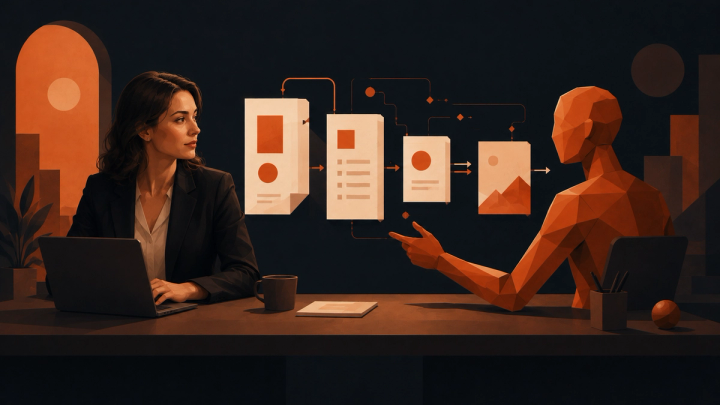
Somewhere in the last eighteen months, the phrase "AI agent" crossed over from research papers into board decks, sales pitches, and job descriptions. Everyone seems to be deploying one. Fewer people can explain what one actually is.
This article is the plain-language primer we wish existed when we started building in this space. No hype, no jargon. Just a clear explanation of what agents are, where they came from, and how to think about whether your business should care.
What is an AI agent, exactly?
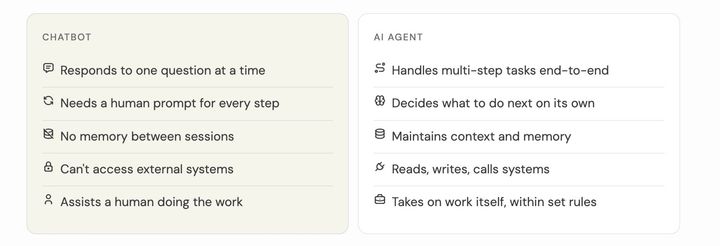
A chatbot answers questions. An AI agent gets things done.
The technical definition: an AI agent is a software system that perceives its environment, makes decisions, and takes actions — often across multiple steps — to accomplish a goal. It doesn't wait to be prompted at every turn. It works.
Think of the difference between a search engine and a new hire. A search engine returns information. A new hire reads it, decides what to do next, and goes and does it.
In practice, this means an agent can read a document, identify what action is needed, access a relevant system, produce an output, flag what needs human review, and route it — all in sequence, without a human in the loop for each step. The human sets the goal; the agent manages the work.
What makes today's agents different from earlier automation is that they aren't following a rigid script. They reason. They handle variation, ambiguity, and novel inputs. That's the breakthrough — not speed, but judgment.
How did we get here?
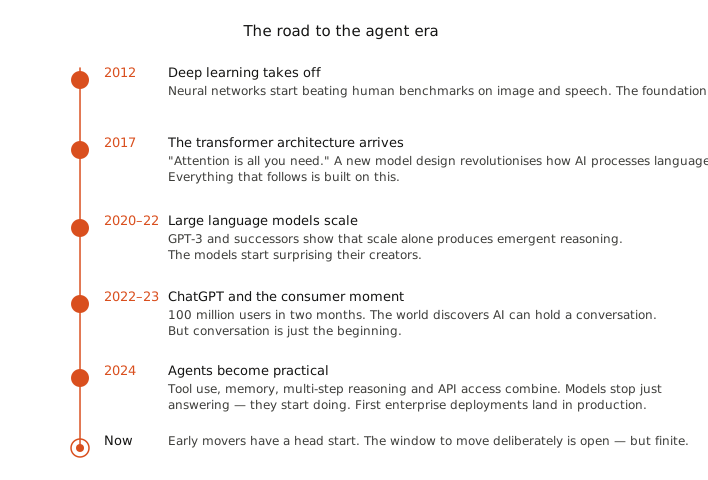
The agent era didn't appear overnight. It's the result of a decade of compounding capability:
Chatbots vs. agents: what's the real difference?
Who should be thinking about this?
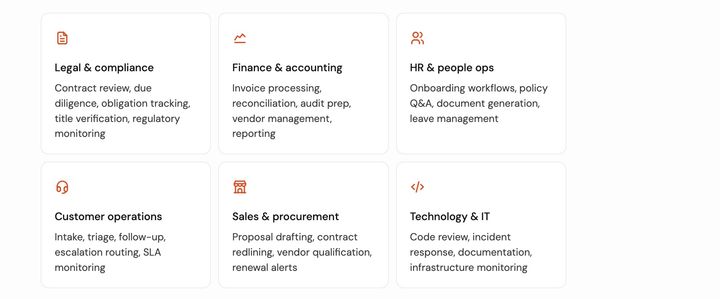
The short answer: any organization where knowledge workers spend meaningful time on repeatable, document-heavy, or process-driven work. That's a much wider net than most people assume.
The longer answer depends on your function. Agents are showing the most early traction in:
Is this only for large enterprises?
No — and this is perhaps the most important misconception to correct.
The first generation of enterprise software (ERP, CRM, document management) was genuinely out of reach for smaller companies. It required large IT teams, expensive implementations, and multi-year rollouts. The barrier was real.
AI agents work differently. The same model capability that powers a Fortune 500 deployment is accessible via API. The cost curve is usage-based, not seat-based. A ten-person legal team can deploy a contract-drafting agent at a fraction of what hiring a junior associate would cost.
If anything, the ROI case is often clearer for smaller teams — because every hour saved is a higher percentage of total capacity.
The questions that matter aren't about size. They're about process maturity (do you have repeatable workflows?), data availability (can an agent be trained on your firm's actual work?), and governance (are you comfortable with defined rules for what the agent can and can't do unsupervised?).
A 15-person in-house legal team, a 30-person accounting firm, a regional bank's compliance department — all of these are realistic deployment targets today.
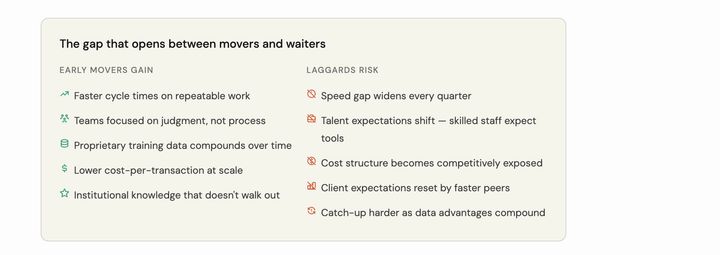
What do early movers gain — and what do laggards risk?
Agents already at work: what this looks like in practice
Every year, JPMorgan's legal team faced 360,000 hours of work reviewing commercial loan agreements — extracting key terms, checking compliance, flagging anomalies, and populating downstream systems. An AI agent now does this in seconds per document. The COiN platform reads each agreement, applies the firm's compliance rules, and routes exceptions to lawyers for review. The legal team moved from processing documents to managing the ones that actually need human judgment.
At Bridgewater Associates, risk officers used to begin each day synthesising overnight data from hundreds of sources — portfolio positions, market movements, compliance thresholds. An internal AI agent now does that synthesis automatically, applies the firm's risk rules, and delivers a structured exception report each morning. The analysts arrive to a briefing, not a pile of raw data. Their time goes to the exceptions that matter, not the aggregation that doesn't.
Managing supplier contracts across a global operation means thousands of documents, dozens of jurisdictions, and renewal dates that quietly slip past busy teams. DHL deployed an AI agent to handle the intake and review of procurement contracts at scale — reading each one against master terms, scoring deviations by risk level, extracting obligations to a live calendar, and routing routine approvals automatically. The backlog that once stretched weeks cleared within months. Their legal and procurement teams shifted from processing to oversight.
At Troup, we built Nora for exactly this kind of work in legal teams that don't have JPMorgan's engineering budget. Nora is a named contract drafting specialist that law firms and in-house teams subscribe to as they would a senior hire. When a matter opens, Nora is briefed on the parties, jurisdiction, and deal type. She drafts from the firm's templates and clause library, applies standard negotiating positions, and flags anything outside pre-approved parameters for partner review. The supervising lawyer receives a structured draft and a plain-language summary of every decision made. Nothing goes out without approval — that's a locked rule, not a preference. The firm gets the throughput of automation with the governance structure they actually need.
Where do we go from here?
The agent era is not a future event. It's underway. The question isn't whether AI agents will reshape how knowledge work gets done — it's whether your organization will be among those who shaped that change, or among those who adapted to it after the fact.
Curious what an agent could do for your team?
We build named specialist agents for medium and large businesses. If you'd like to explore what this looks like for your specific workflow, we're happy to spend 30 minutes walking through it with you. Contact us for a demo.